For years, we got used to thinking that artificial intelligence lived “in the cloud.” You typed a question, someone with massive servers answered it, and that was it. But AI is changing shape, and with it, the place where it makes sense to run it is changing too. The new wave isn’t chatbots: it’s autonomous agents that perceive, reason, act, and remember. And surprisingly, that shifts the focus back to something very physical: the machine sitting under your desk.
From Chatbot to Agent: What Really Changed
In his recent presentation on agentic systems and OpenClaw, Chaume summarized it with a simple image: an agent operates in a continuous loop.
Perceives: gathers information from its environment (your email, documents, a website, a database).
Reasons: decides what to do with that information and plans the necessary steps.
Acts: executes real actions by connecting to tools such as WhatsApp, Slack, or Telegram.
Remembers: maintains context between steps instead of starting from scratch every time.mantiene contexto entre pasos para no empezar de cero cada vez.
The difference from a traditional chatbot is enormous. A chatbot responds; an agent gets things done. And to “do” things continuously, it needs far more memory, consistency, and, above all, a reliable place to run.
OpenClaw and Agent Orchestration
OpenClaw is the piece that turns that theory into something manageable: it orchestrates multiple agents and tools so they can work together. Instead of a single model generating responses, you have a system that researches, writes, reviews, and publishes in a coordinated way. The leap Chaume described is precisely this: moving from a simple “gateway” (a point that receives requests) to the true orchestration of complex tasks.
But that coordination comes at a cost: the more agents and context involved, the more resources the system consumes. This is where many experiments hit a wall.
The Bottleneck: Memory
Remember when 32GB of RAM seemed more than enough? With local agents, that amount quickly becomes limiting. Keeping multiple language models loaded simultaneously, maintaining each agent’s context, and orchestrating tools through OpenClaw can exhaust available memory in a matter of minutes. That’s why the hardware chosen during testing was a Slimbook One.
Why the Slimbook One Fits This Scenario
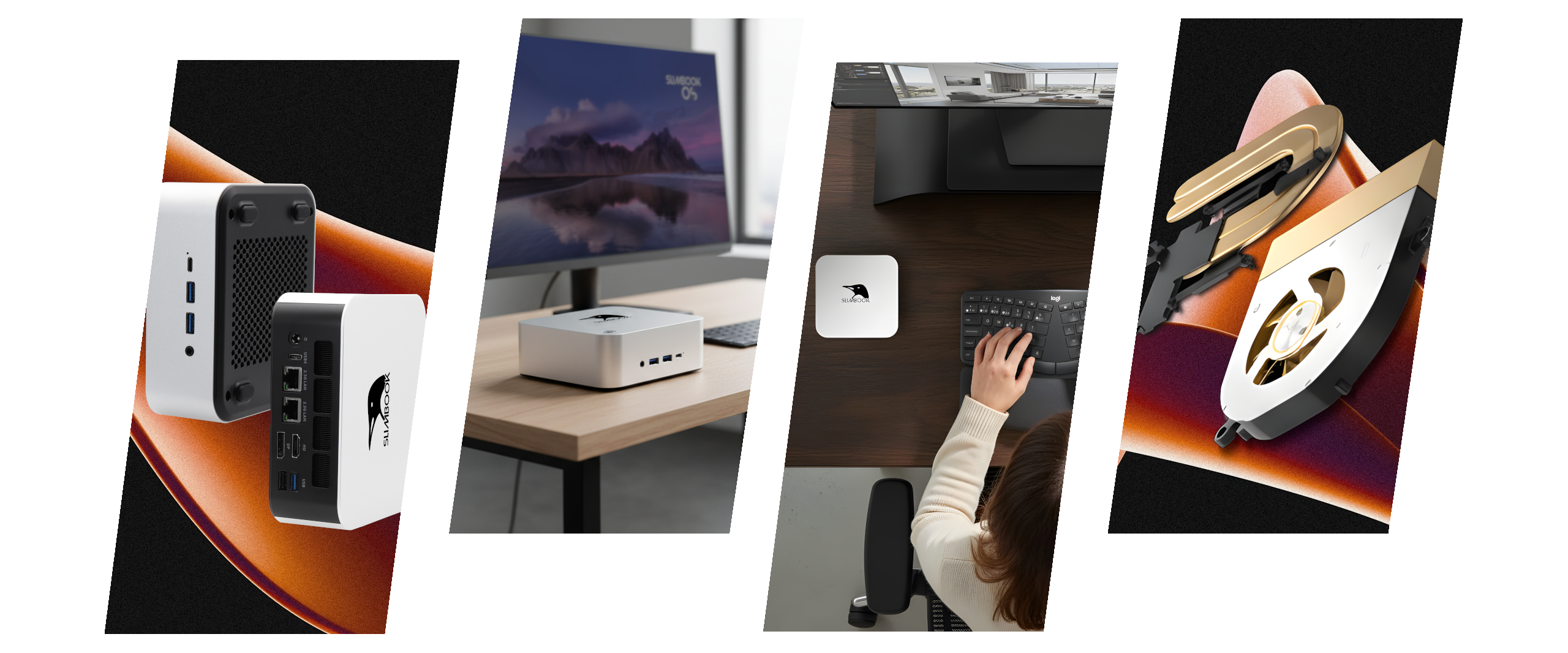
It’s no coincidence. The Slimbook One is a mini PC designed for this new era of local AI, bringing together exactly what an agentic system needs:
AMD Ryzen AI 9 HX 370 processor (12 cores, Radeon 890M graphics) with an integrated 50 TOPS NPU and up to 80 combined TOPS (CPU + NPU) to accelerate AI workloads.
Up to 128GB of DDR5 RAM, the decisive factor for running multiple local LLMs (such as Llama or DeepSeek) without running out of resources.
Dual PCIe 4.0 NVMe storage, ideal for vector databases (RAG) and high-speed data movement.
Oculink port, enabling connection to an external eGPU and desktop-class graphics performance whenever needed.
Compact and quiet design, only 15 cm wide with a premium aluminum finish: server-level power in a device that fits on your desk.
The Advantage You Won’t Find on the Spec Sheet: Data Sovereignty
When an agent researches competitors, writes marketing copy, or accesses your brand guidelines, it is handling strategic information. Running it locally on your own machine means that data never leaves your infrastructure. No sending your company’s most sensitive information to someone else’s cloud, and no dependence on costly external APIs for every action.
That is the true promise of self-hosted AI: control, privacy, and predictable costs. Local hardware stops being a technical detail and becomes a strategic decision.
Who Is This For?
You don’t need to be a research lab. This approach makes sense for many different profiles:
Marketing teams looking to automate research, copywriting, and multichannel content creation.
Developers using agents to audit or generate code without exposing their repositories.
Professionals and consultancies handling confidential data that cannot be sent to the cloud.
Anyone who wants to experiment with AI agents without facing an ever-growing monthly API bill.
Conclusion: AI Is Coming Back to Your Desk
Chaume’s presentation delivered a clear message: agentic AI is no longer a distant promise. It’s already here, performing real-world actions today. What’s interesting is that this future doesn’t necessarily live in a remote data center—it can run, with complete sovereignty, right on your desk. And for that, you need hardware capable of keeping up.
The Slimbook One is currently one of the most sensible ways to take that step: server-class performance, complete privacy, and a form factor that doesn’t take over your workspace.
👉 Discover the Slimbook One and build your own local AI hub.