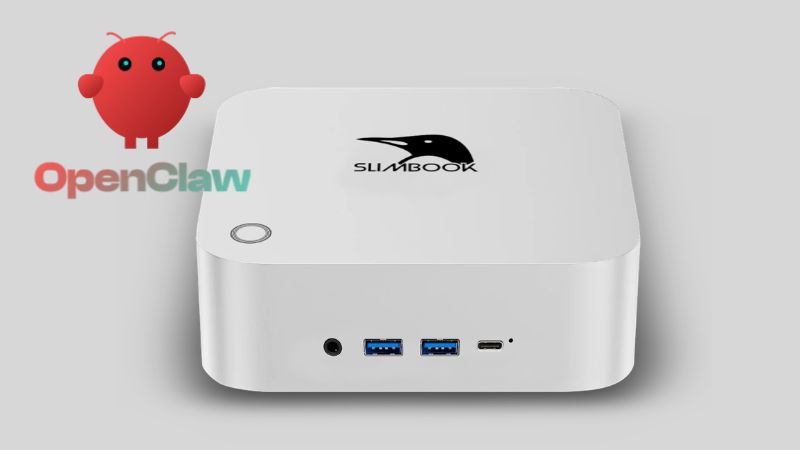
The mini PC market is undergoing a radical shift. For years, Apple's Mac Mini has been the gold standard for those seeking massive power in a compact form factor. However, the arrival of the Slimbook ONE breaks this mold, positioning itself as the ultimate Linux alternative and the strongest rival against closed ecosystems. It's not just a high-performance small computer; it is an open machine specifically optimized to lead the new era of computing: the era of local AI agents.
From Answering Questions to Executing Actions: The Mini PC as an Autonomous Agent
While most users interact with Artificial Intelligence through simple commercial chatbots in the cloud, the Slimbook ONE allows for a true evolutionary leap thanks to its seamless integration with the OpenClaw open-source framework. Here, the mini PC stops being a passive tool and becomes an autonomous agent capable of interacting directly with the Linux operating system to execute real tasks, automate workflows, launch scripts, and manage files independently.
Thanks to this agentic approach, the Slimbook ONE can be configured to operate unattended in workflows such as:
Technical Automation and DevOps: Launching server deployments, monitoring infrastructure in real time, and intelligently orchestrating containers..
Enterprise Agentic Architectures: Coordinating multi-agent workflows that automate complex corporate processes by interacting with internal tools.
Operational AI: Safely interacting with external APIs and processing local data without requiring constant supervision..
Why It Surpasses the Limitations of Closed Ecosystems
In contrast to Apple’s soldered, unified memory model, the Slimbook ONE offers scalable server-grade features that make it the ideal environment for local AI development and inference:
Cutting-Edge Ryzen AI Power: Equipped with AMD Ryzen AI 9 HX 370 processors, which feature a next-generation integrated NPU dedicated to accelerating Artificial Intelligence processes.
Unrivaled Memory: Supports massive configurations of up to 128 GB of DDR5 RAM. This is vital for loading multiple large language models (LLMs via Ollama) simultaneously, far exceeding the memory limits of traditional compact systems.
Massive Storage: Dual slots for NVMe PCIe 4.0 drives, making it easy to host massive databases for RAG (Retrieval-Augmented Generation) systems.
Total Privacy and Technological Sovereignty
The greatest advantage of turning the Slimbook ONE into your AI agent hub is privacy. By running local models, companies and developers eliminate network latency, avoid the variable costs of commercial cloud APIs, and guarantee that sensitive data never leaves the device. It is technological sovereignty in a format that fits in the palm of your hand.
Flexibility via eGPU
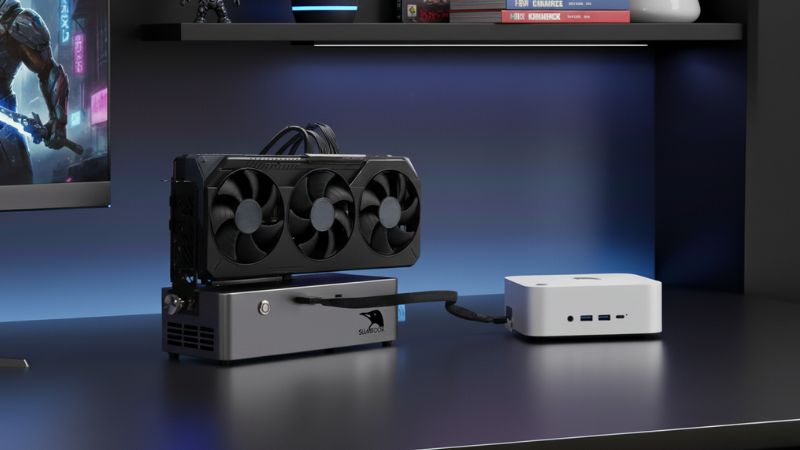
One of the biggest disadvantages of other compact alternatives on the market is their zero capacity for hardware expansion after purchase. Slimbook solves this by introducing high-speed Oculink and USB4 ports.
Although the mini PC is extremely powerful on its own, a great way to add even more power to the system is by connecting an eGPU. If your AI agents need to work with advanced computer vision, massive multimodal workflows, or heavy Machine Learning pipelines, the Oculink connection offers a direct PCIe bandwidth equivalent to a traditional desktop tower, but with the flexibility of using it only when you need that extra brute force.
⚠️ Safety Note: By allowing OpenClaw to act directly on the system, implementing best practices is fundamental: strict permission control, environment isolation (sandboxing), and active monitoring of the agents, especially within enterprise infrastructures.
Looking to Go Much Further? Discover the NVIDIA DGX Spark
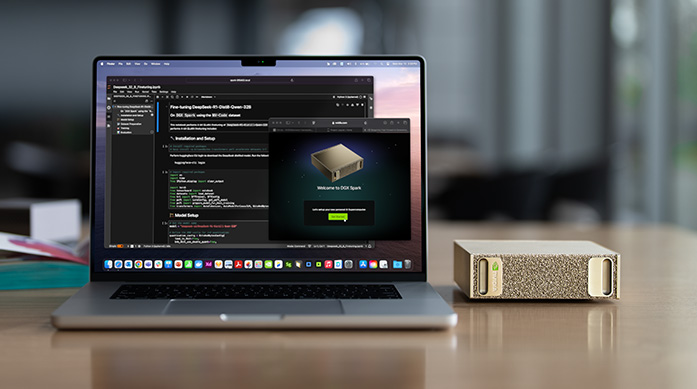
We understand that some projects, due to their scale, data volume, or scientific computing demands, need to push past the limits of a conventional mini PC (even one equipped with an eGPU). If you are looking for an industrial-grade workstation right on your development desk, we now also offer the new NVIDIA DGX Spark through our website. NVIDIA DGX Spark.
This device is a true "pocket-sized AI supercomputer" designed around the revolutionary NVIDIA GB10 Grace Blackwell Superchip. In an ultra-compact chassis similar to a NUC, the DGX Spark provides you with:
1 PetaFLOP of AI performance (FP4) under low power consumption.
128 GB of coherent, unified system memory (LPDDR5x) shared directly between the CPU and GPU via NVLink.
Pre-installed NVIDIA AI Enterprise software stack (DGX OS, CUDA, TensorRT) ready for rapid prototyping and fine-tuning of advanced agentic models and workflows up to 70B parameters.
Si el ecosistema de mini PC tradicional se te queda corto, el DGX Spark es el siguiente escalón profesional hacia el que migrar tu infraestructura local.
Helping You Choose Based on Your Needs: Slimbook ONE, ONE + eGPU, DGX Spark... or a Desktop Tower?
If you still have doubts about which option best fits the scale of your Artificial Intelligence projects, we can easily classify them using this analogy:
The Slimbook ONE (Standalone) is a premium sedan: It is compact, elegant, and highly efficient for day-to-day use; the ideal choice if you are looking to run your own local agents and agile inference tasks while taking up minimal space on your desk.
The Slimbook ONE + eGPU is a convertible or modular car: You get the comfort and size of a compact car for your daily routine, but with the versatility to "drop the top" and connect extra external graphics power (eGPU) via Oculink only when your computer vision workflows or heavy pipelines require it.
A traditional desktop tower is a classic sports car: It permanently delivers brutal graphics power and speed in a rigid, fixed chassis. However, it forces you to sacrifice a massive amount of physical space in your setup and draws much more power continuously.
El NVIDIA DGX Spark The NVIDIA DGX Spark is comparable to a specialized engineering vehicle: It stands out not because it is more powerful than a desktop gaming graphics card or a high-end eGPU, but because it offers a massive amount of unified memory and an ecosystem designed specifically for low-power development.
The paradigm has shifted, and software is no longer a limit. Now it's your turn to choose the size and flexibility of the technological engine your next big project requires.